
Introduction
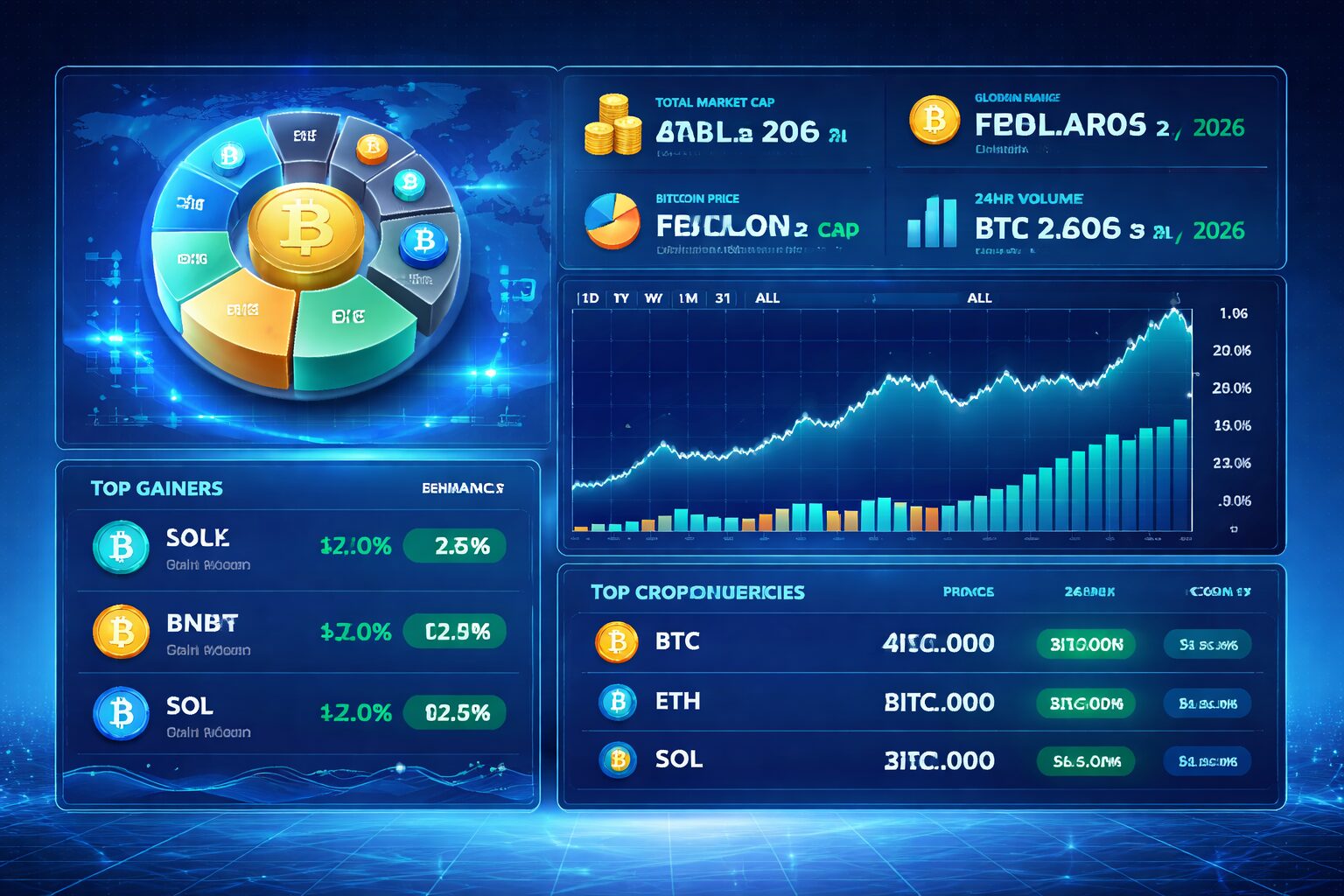
The global cryptocurrency market on February 2 2026 reflects a phase of intense volatility and transition as digital assets respond to shifting macroeconomic forces regulatory developments and evolving investor behavior. After a powerful rally in late 2025 that saw Bitcoin and several major altcoins reach historic highs the new year has begun with a period of correction. This environment has tested market confidence while also reshaping long term strategies for institutions retail investors and blockchain innovators.
Bitcoin the largest and most influential cryptocurrency has remained under pressure as traders reassess valuations and manage risk. Ethereum has followed a similar path experiencing sharper percentage declines due to profit taking and sector rotation. Across the broader market altcoins have shown mixed performance with some sectors struggling while others display resilience. This moment marks an important chapter in the maturation of the digital asset industry.
Market Overview: A Broad Based Correction
The cryptocurrency market has entered a corrective phase after months of strong upward momentum. Bitcoin which surged dramatically in late 2025 has now retraced a portion of its gains. This shift reflects a natural market cycle in which rapid appreciation is followed by consolidation and revaluation. Ethereum and many leading altcoins have mirrored this movement with notable volatility and heavy trading volumes.
Market participants have become more cautious as liquidity tightens and speculative activity slows. Traders are reducing leverage and focusing on capital preservation rather than aggressive expansion. This has led to thinner order books and wider price swings even on moderate volume. The overall mood across exchanges is one of strategic pause rather than panic.
Bitcoin Under Pressure But Structurally Strong
Bitcoin continues to act as the central pillar of the crypto economy. While its price has declined from recent highs the network fundamentals remain intact. Hash rate remains strong wallet adoption continues to grow and institutional custody solutions are expanding. The current drawdown appears to be driven more by macroeconomic conditions and market structure than by any weakness in the Bitcoin protocol itself.
Investors are paying close attention to support levels and long term trend lines. Many long term holders remain confident that Bitcoin is still in a larger growth cycle supported by scarcity institutional demand and increasing global acceptance as a digital store of value. Short term volatility has not shaken the conviction of strategic investors.
Ethereum And The Smart Contract Economy
Ethereum has experienced sharper percentage declines compared to Bitcoin. This is partly due to its role as the backbone of decentralized finance NFT platforms and Web3 applications. When market sentiment shifts toward risk reduction Ethereum tends to face heavier selling pressure.
Despite the short term price weakness development activity on Ethereum remains strong. Layer two scaling solutions are expanding adoption and improving transaction efficiency. Builders continue to deploy applications in gaming identity tokenization and finance. These innovations reinforce Ethereum’s long term value even as its price fluctuates.
Altcoins Sector Rotation And Selective Strength
While many altcoins have followed the broader market downtrend some sectors have shown relative resilience. Tokens associated with scalability privacy infrastructure and social finance platforms have attracted attention from investors seeking long term innovation exposure. This indicates that capital is rotating within the market rather than exiting entirely.
Meme coins and highly speculative tokens have experienced deeper pullbacks as traders unwind short term positions. Utility driven projects with strong developer communities and real world use cases are holding value better than purely hype driven assets. This suggests that the market is becoming more selective and mature.
Institutional Activity And Market Structure
Institutional investors played a major role in driving the 2025 rally through exchange traded products custody services and corporate treasury allocations. In early 2026 many of these players are reassessing exposure as macroeconomic uncertainty increases. This has resulted in a temporary slowdown in inflows and a more defensive posture across professional trading desks.
However institutional interest has not disappeared. Many firms are focused on building infrastructure including derivatives markets options products and custody compliance frameworks. These efforts indicate that long term integration between traditional finance and crypto markets continues to advance even during periods of price weakness.
Regulation And Global Policy Shifts
Regulation remains one of the most powerful forces shaping the crypto industry. Governments around the world are introducing licensing regimes for exchanges custodians and stablecoin issuers. These frameworks aim to improve transparency protect consumers and reduce illicit financial activity.
While regulation introduces short term friction it also brings long term legitimacy. As legal clarity improves institutional participation becomes easier and mainstream adoption grows. Jurisdictions that strike a balance between innovation and oversight are likely to become hubs for digital asset development.
Investor Sentiment And Community Dynamics
Retail investor sentiment is mixed. Some traders express frustration with the recent downturn while others view it as a buying opportunity. Long term believers remain focused on adoption metrics technological progress and macro trends such as digital identity tokenization and decentralized infrastructure.
Community discussion across forums and social platforms reflects emotional extremes common in volatile markets. Fear and optimism coexist often within the same investor groups. This psychological dimension plays a significant role in short term price action but has less influence on long term value creation.
Technology And Innovation As Long Term Drivers
Despite market turbulence innovation continues at full speed. Developers are building faster blockchains, better wallets, decentralized identity systems and interoperable networks. Artificial intelligence integration with blockchain data analytics is expanding use cases in finance supply chains and governance.
These developments suggest that crypto is evolving from a speculative asset class into a foundational layer of the digital economy. Market corrections often serve as periods of rebuilding and refining where strong projects emerge more clearly.
The Road Ahead: What Investors Should Watch?
The coming months will be shaped by three major forces: macroeconomic conditions, regulatory clarity and technological progress. Interest rate policy liquidity cycles and global financial stability will influence capital flows into risk assets including crypto. Regulation will determine where innovation clusters and how institutions engage. Technology will define which platforms deliver real value.
Investors should focus on risk management diversification and long term vision. Volatility is a feature of crypto markets not a flaw. Those who understand the underlying transformation of digital finance are better positioned to navigate uncertainty and benefit from future growth cycles.
Conclusion
February 2 2026 represents a pivotal moment for the cryptocurrency industry. The market is cooling after an explosive expansion but the foundation for long term growth remains strong. Bitcoin Ethereum and the broader ecosystem continue to evolve through innovation regulation and institutional integration.
Rather than signaling the end of opportunity this phase reflects the maturation of a new financial system. Crypto is no longer just an experiment. It is becoming an essential component of the global digital economy and its future will be shaped by those who build responsibly, invest wisely and adapt intelligently.