
Introduction
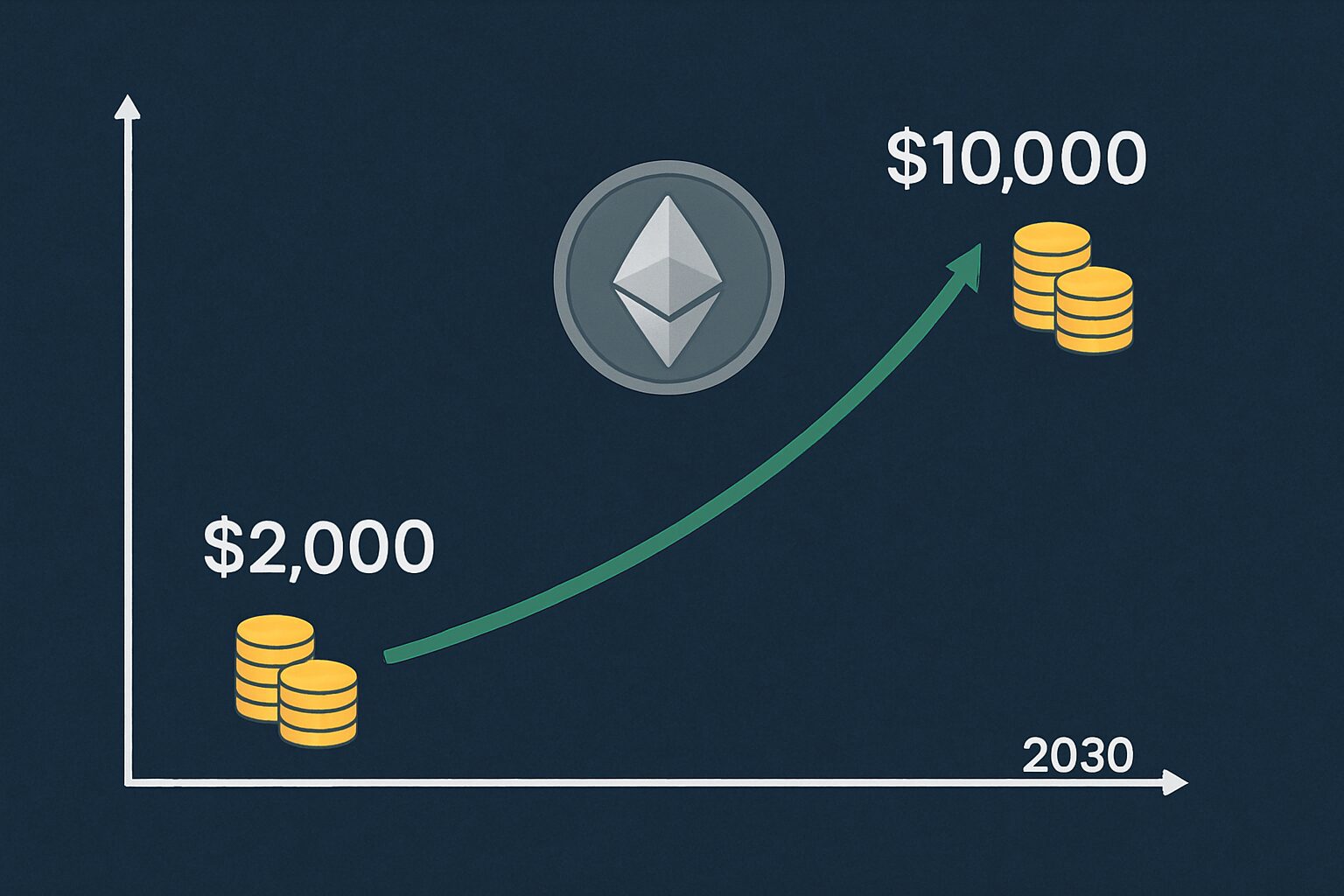
The cryptocurrency space continues to spark the interest of long-term investors, particularly those eyeing Ethereum, the second-largest cryptocurrency by market capitalization. With the rising popularity of blockchain technology and Ethereum’s expanding ecosystem, many are now asking: Could a $2,000 investment in Ethereum today realistically turn into $10,000 by the year 2030?
To answer this question, we must analyze Ethereum’s current position in the market, its historical growth trajectory, upcoming technological developments, adoption metrics, and broader economic trends. This article offers a deep dive into all these factors, giving you a well-rounded forecast on Ethereum’s long-term investment potential.
Understanding Ethereum: More Than Just A Cryptocurrency
Ethereum is a decentralized, open-source blockchain platform that supports smart contracts — self-executing contracts where terms are directly written into code. Introduced by Vitalik Buterin in 2015, Ethereum was designed to expand the use of blockchain beyond just financial transactions.
Unlike Bitcoin, which primarily acts as a digital currency, Ethereum’s blockchain is a fully programmable infrastructure supporting decentralized applications (dApps), non-fungible tokens (NFTs), and decentralized finance (DeFi). The native currency, ETH, powers this vast network by paying transaction fees and acting as a store of value.
This distinction is vital because Ethereum’s value proposition is not just based on scarcity or speculation; it is driven by utility, network adoption, and developer engagement — all critical indicators for long-term investment potential.
Ethereum’s Historical Performance: A Proven Growth Engine
Ethereum has demonstrated exponential growth since its inception. In 2015, the initial price of ETH during its ICO was roughly $0.30. By 2017, it surged past $1,000 during the initial crypto bull market. Despite experiencing volatility, Ethereum reached an all-time high of over $4,800 in November 2021. Even after multiple corrections, it remains one of the most resilient and widely used blockchain assets.
CAGR Analysis (2015–2025)
If we analyze Ethereum’s compound annual growth rate (CAGR) from its ICO to mid-2025, it reveals an average return of over 100% annually — far surpassing traditional assets like gold, stocks, and real estate. While past performance does not guarantee future returns, the consistent innovation and ecosystem growth make Ethereum a strong contender for continued appreciation.
Can Ethereum Reach 5x In 5 Years?
A key consideration in projecting the future value of Ethereum is whether it can grow 5x over the next five years — from $2,000 to $10,000. This requires a detailed look at market catalysts and investment fundamentals that could drive such appreciation.
Ethereum 2.0 and Proof of Stake
One of the most critical changes Ethereum has undergone is the transition from Proof of Work (PoW) to Proof of Stake (PoS). Ethereum 2.0 — now fully live — drastically reduces energy consumption by over 99% and introduces staking rewards that encourage holding rather than selling.
This upgrade also lays the groundwork for future scalability through sharding, which will increase transaction throughput and reduce gas fees — two long-standing barriers to mass adoption.
Smart Contract And dApp Ecosystem
Ethereum powers a substantial portion of decentralized applications across industries like finance, gaming, identity management, and logistics. Platforms like Uniswap, Aave, Compound, and MakerDAO are built on Ethereum and handle billions in daily transaction volumes.
With increased adoption of decentralized finance and Web3 tools, Ethereum’s role as the base layer for digital innovation becomes increasingly critical. As more use cases emerge, demand for ETH as gas will grow proportionally.
The Role of Layer 2 and Interoperability
One common critique of Ethereum is its scalability. However, the rise of Layer 2 scaling solutions such as Arbitrum, Optimism, and zkSync have alleviated pressure from the mainnet. These technologies reduce transaction costs and improve speeds, enhancing the user experience while retaining Ethereum’s security.
Additionally, Ethereum’s compatibility with other blockchains through bridges and interoperability protocols ensures it remains central to the evolving blockchain economy.
Institutional Adoption And ETF Momentum
As with Bitcoin, institutional interest in Ethereum has been growing steadily. Major investment firms, hedge funds, and asset managers are allocating to ETH, recognizing its long-term potential. Regulatory discussions in several regions, especially the U.S. and Europe, point toward potential Ethereum ETFs, which would open the gates for retail investors and retirement portfolios.
Such developments could significantly boost capital inflow, market credibility, and long-term price stability — all crucial for 5x growth.
Ethereum’s Supply Dynamics: Deflationary Pressure
Since the implementation of EIP-1559 in August 2021, Ethereum has introduced a burn mechanism that destroys a portion of transaction fees. When network activity is high, ETH can become deflationary — reducing its total supply over time.
Combined with staking (which locks up large volumes of ETH), this creates supply scarcity — a critical element for driving price appreciation. Basic economics suggests that if demand rises and supply contracts, prices are likely to increase.
The Math Behind The $10,000 Goal
Now let’s analyze the core question — can a $2,000 investment in ETH reach $10,000 by 2030?
If you invest $2,000 at the current price of ~$3,500 per ETH (as of July 2025), you would hold approximately 0.57 ETH. To reach $10,000 in portfolio value by 2030, Ethereum would need to be valued at approximately $17,500 per coin — about a 5x increase.
Is this possible? Consider the following:
Bitcoin’s previous cycles show similar or greater returns over 5–6 years.
Ethereum is expanding utility, not just serving as a store of value.
Institutional adoption and ETF vehicles could bring trillions of dollars into the crypto space.
Deflationary supply and increased demand provide strong economic pressure for higher valuation.
While speculative, a $17,500 ETH price by 2030 is within reason based on historical trends and evolving fundamentals.
Risks And Volatility: What Could Go Wrong?
No investment is without risk — and Ethereum is no exception.
Regulatory Headwinds
The biggest wildcard is regulatory action. While clarity is improving, unfavorable regulations in key markets could limit access or hinder innovation.
Security Threats
Although Ethereum is highly secure, risks such as smart contract bugs, bridge exploits, and Layer 2 vulnerabilities still exist.
Competitor Blockchains
Emerging platforms like Solana, Avalanche, and Cardano are innovating fast. While Ethereum remains dominant, competition may slow growth.
Macro-Economic Factors
Interest rates, recessionary pressures, and dollar strength can impact capital allocation to risk assets like ETH.
Despite these risks, Ethereum’s active developer community, massive user base, and continuous upgrades position it better than most altcoins to weather market uncertainties.
ETH Vs. Other Altcoins: Why Ethereum Stands Out?
While thousands of altcoins exist, very few have Ethereum’s level of trust, decentralization, and development activity. Unlike smaller tokens that can disappear during bear markets, Ethereum has shown institutional durability and long-term resilience.
It is the blockchain of choice for developers, startups, and enterprises — not just speculators.
How To Maximize Your $2,000 ETH Investment?
If you’re looking to grow your ETH investment to $10,000 by 2030, here are some long-term strategies:
Dollar-Cost Averaging (DCA)
Instead of investing $2,000 in one go, spread your purchase across several months to average out price fluctuations.
Stake Your ETH
By staking your ETH (directly or via services like Lido or Coinbase), you can earn passive income while contributing to network security.
Use Cold Storage
Consider storing your ETH in a hardware wallet to protect your investment from hacks and exchange failures.
Stay Informed
Monitor updates from Ethereum core developers, follow upgrade timelines, and stay ahead of regulatory changes.
Community Strength And Developer Network
Ethereum’s success lies in its community. It boasts the largest developer network of any blockchain platform. Projects continue to be built on Ethereum because of its composability, extensive documentation, and developer incentives.
Final Thoughts
From every angle — technical innovation, network growth, economic fundamentals, and institutional adoption — Ethereum stands out as one of the most promising long-term investments in crypto. While the crypto market is inherently volatile and unpredictable, Ethereum offers a blend of real utility, deflationary supply, and adoption metrics that support significant appreciation.
A $2,000 ETH investment growing to $10,000 by 2030 is not a certainty, but it is absolutely within the realm of possibility, especially for those willing to hold through volatility and focus on long-term value. Investors must always conduct their own research and consider their risk tolerance. However, Ethereum continues to offer one of the best opportunities in digital assets for those who believe in the future of decentralized technology.